
Introduction
In today's dynamic marketing landscape, traditional marketing and digital marketing are not mutually exclusive; they coexist and complement each other. However, they differ significantly in their approaches, tools, and outcomes. Traditional marketing focuses on offline channels like television, radio, print, and billboards to reach a broad audience. Digital marketing, on the other hand, leverages online platforms such as social media, email, and websites to connect with customers and drive sales.
Understanding these differences is crucial for marketers aiming to maximize their engagement and conversion rates. Let's delve into the key differences between traditional and digital marketing.
Key Differences
Medium of Communication
Traditional Marketing: Offline channels such as TV, radio, print, and billboards.
Cost Efficiency
- Traditional Marketing: Offline channels such as TV, radio, print, and billboards.
- "Traditional marketing is about using mass media to reach a broad audience," - John Wanamaker, Founder of Wanamaker's Department Store (1850)[1].
- Digital Marketing: Online platforms like websites, social media, search engines, email, and mobile apps.
- "Digital marketing allows us to target specific audiences with tailored messages, creating a more personalized experience for our customers," - Neil Patel, Digital Marketing Expert[2].
Targeting and Personalization
- Traditional Marketing: Broad targeting with less personalization.
- "Traditional marketing often relies on broad demographics to reach audiences, whereas digital marketing allows for highly targeted campaigns," - David Ogilvy, Advertising Legend (1960)[5].
- Digital Marketing: Highly targeted and personalized using user data.
- "Digital marketing's ability to personalize content based on user behavior is unparalleled," - Brian Solis, Digital Anthropologist (2018).
Interactivity and Engagement
- Traditional Marketing: One-way communication, no immediate interaction.
- "Traditional marketing typically involves one-way communication where brands broadcast messages without immediate feedback," - Al Ries, Marketing Author (1987).
- Digital Marketing: Two-way communication, real-time engagement.
- "Digital marketing fosters a two-way conversation between brands and customers, enabling real-time engagement," - Seth Godin, Marketing Author (2007).
Measurability and Analytics
- Traditional Marketing: Limited measurement, hard to link to direct sales.
- "Traditional marketing metrics are often subjective and difficult to quantify, making it challenging to measure campaign effectiveness," - Martin Sorrell, Former WPP CEO (2009).
- Digital Marketing: Real-time tracking and analytics (clicks, conversions).
- "Digital marketing provides detailed analytics that allow marketers to measure campaign performance in real-time," - HubSpot CEO Brian Halligan (2012).
Reach and Accessibility
- Traditional Marketing: Local/regional reach, costly to expand globally.
- "Traditional marketing has a limited global reach, requiring significant resources to expand beyond local markets," - Rupert Murdoch, Media Mogul (2000).
- Digital Marketing: Global reach with language and cultural customization.
- "Digital marketing can target international audiences with ease, adapting to various languages and cultural preferences," - Facebook COO Sheryl Sandberg (2013).
Speed and Adaptability
- Traditional Marketing: Slow to adjust; requires advance planning.
- "Adjusting traditional marketing campaigns can be time-consuming due to the production and distribution cycles involved," - Procter & Gamble CEO A.G. Lafley (2005).
- Digital Marketing: Quick to launch and adjust based on performance data.
- "Digital marketing campaigns can be launched rapidly and modified in real-time based on performance data," - IBM CEO Ginni Rometty (2012).
Content Format and Creativity
- Traditional Marketing: Static formats like print ads or billboards.
- "Traditional marketing often relies on static content formats that lack the dynamism of digital media," - Apple Marketing Chief Phil Schiller (2011).
- Digital Marketing: Supports a wide range of content formats, including videos, infographics, podcasts, interactive ads, animations, and augmented reality experiences.
- "Digital marketing offers endless creative possibilities with formats like videos, infographics, and interactive ads," - LinkedIn CEO Ryan Roslansky (2020).
Customer Feedback Loop
- Traditional Marketing: Takes longer to collect customer feedback.
- "Collecting customer feedback through traditional marketing methods can be a lengthy process," - Coca-Cola’s former CMO, Joe Tripodi (2013).
- Digital Marketing: Provides instant feedback from customers through reviews, social media comments, and online surveys.
- "Digital marketing allows brands to respond to customer feedback quickly, enhancing customer satisfaction," - Salesforce CEO Marc Benioff (2015).
Longevity and Shelf Life
- Traditional Marketing: Fixed shelf life, such as a 30-second TV spot or a month-long billboard campaign.
- "Traditional marketing ads have a limited shelf life once their campaign period ends," - McKinsey & Company’s David Court (2009).
- Digital Marketing: Can be turned on and off as needed; content like blogs, videos, or social media posts continue to attract traffic long after they are published.
- "Digital marketing campaigns can be dynamic, with content remaining relevant for an extended period," - Content Marketing Institute’s Joe Pulizzi (2016).
Case Studies: Traditional Marketing
California Milk Processor Board’s “Got Milk?” Campaign
Launched in 1993, the “Got Milk?” campaign aimed to increase milk consumption by highlighting its importance in popular culture. The strategic use of print and television ads featuring celebrities with milk mustaches created a memorable and humorous image that resonated with audiences. The campaign successfully boosted milk sales across the United States[2].
Old Spice’s “The Man Your Man Can Smell Like” Campaign
In 2010, Old Spice revitalized its brand with the “The Man Your Man Can Smell Like” campaign. The humorous ads featuring an engaging male spokesperson delivered tongue-in-cheek messages about masculinity and grooming. The creative approach garnered significant attention, leading to increased sales and brand visibility. This case exemplifies the importance of humor and relatability in traditional marketing[2].
Coca-Cola, John Deere, Ford
These brands have effectively leveraged traditional marketing methods such as print, television, radio, and direct mail channels to reach their target audiences. Coca-Cola, for instance, increased brand awareness and consumer engagement through compelling advertisements. John Deere strengthened its connection with agricultural communities using direct mail campaigns. Ford boosted vehicle sales by telling compelling stories through television and print ads[2].
Recent Trends and Future Predictions in Marketing
Digital Marketing Trends
Digital marketing continues to evolve with emerging trends like artificial intelligence, machine learning, and augmented reality. These technologies enhance personalization, interactivity, and measurability, making digital marketing more effective than ever. According to a study by HubSpot, by 2025, personalization will become increasingly important in digital marketing strategies.
Integration of Traditional and Digital Marketing
As the lines between traditional and digital marketing blur, brands are integrating both approaches to maximize their reach. For instance, local businesses can benefit from traditional advertising by tapping into local attention, but they should also invest in digital marketing to track key performance indicators (KPIs) crucial for campaign success[3].
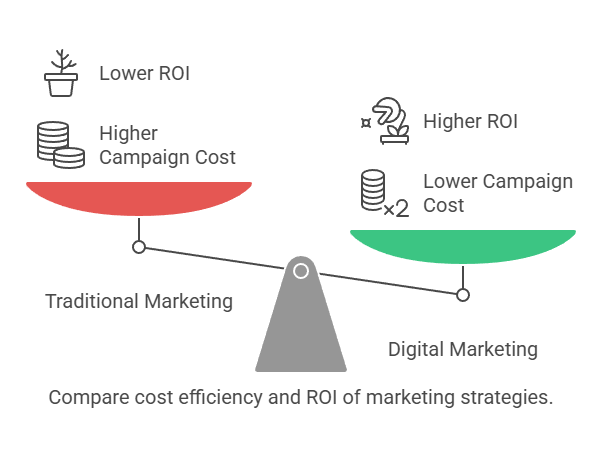
Key Elements:
- Cost per campaign
- ROI (Return on Investment)
- Average cost for traditional vs digital marketing
Conclusion
In conclusion, traditional marketing and digital marketing each have their strengths and weaknesses. While traditional marketing excels in broad reach and cost efficiency, digital marketing offers precision targeting, real-time analytics, and interactivity. By understanding these differences and integrating both approaches, marketers can create comprehensive strategies that maximize their impact.
